Gehlot-Pilot Bonhomie Raises Question: Rajasthan Congress Unity or Election Optics?
A light-hearted exchange between Ashok Gehlot and Sachin Pilot at a Congress strategy meeting in Jaipur has drawn attention in Rajasthan's political circles, reviving questions.
Written by
Anupam Pandey
Published
8 October 2026
Reading time
4 min read
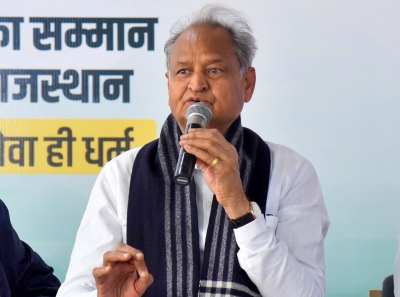
A light-hearted exchange between Ashok Gehlot and Sachin Pilot at a Congress strategy meeting in Jaipur has drawn attention in Rajasthan's political circles, reviving questions.
The two senior Congress leaders, whose political rivalry has been one of the defining features of the party's internal politics in Rajasthan, appeared relaxed during the meeting. They were seen smiling and exchanging jokes in the presence of other party leaders.
At one point, Gehlot referred jokingly to Pilot's earlier equation with Punjab Congress in-charge Sukhjinder Singh Randhawa. Pilot responded by telling Gehlot that it did not matter who was in charge because Gehlot was “in charge of all of us”. Gehlot replied, “I am the permanent in-charge,” prompting laughter among those present.
The exchange presented a markedly different picture from the political confrontations that have characterised the relationship between the two leaders over the years. But whether the bonhomie represents a genuine political reconciliation remains a more complicated question.
Around 20 senior Congress leaders attended the Jaipur strategy meeting, including Gehlot, Pilot, Rajasthan Pradesh Congress Committee chief Govind Singh Dotasra, Randhawa and Leader of Opposition Tika Ram Jully. The immediate objective was to prepare the party for the Panchayat elections.
The presence of the party's major leadership figures around the same table carried significance because Rajasthan Congress has long had multiple centres of influence. The Gehlot-Pilot rivalry has been the most prominent fault line, while differences between Gehlot and Dotasra have added another layer to the party's internal dynamics.
Against this background, the decision to project collective leadership sends a clear political message: at least for the upcoming electoral battle, the Congress wants its internal disagreements to take a back seat.
The real test, however, will be whether that message extends beyond the meeting room in Jaipur and reaches the party's organisational structure and grassroots campaign in Rajasthan.
Gehlot and Pilot have experienced confrontation, rebellion, reconciliation and renewed differences during their political relationship. Their disagreements have at times overshadowed organisational issues within the Rajasthan Congress. The latest meeting, therefore, attracted attention precisely because of the absence of visible friction between them.
The Congress appears keen to replace the imagery of competing factions with that of collective leadership. The Panchayat elections offer a practical reason for doing so, given the importance of coordination at the grassroots level.
At the same time, differences involving Dotasra remain another factor for the party to manage. Questions over campaign strategy and organisational coordination emerged after the Congress's performance in recent urban local body elections.
Gehlot had questioned whether a more effective strategy and greater unity during the campaign could have produced a different outcome. This brought renewed attention to the functioning of the state organisation under Dotasra.
Pilot, however, defended Dotasra, saying the PCC chief had followed a sound strategy and taken party leaders along. The contrasting positions again highlighted the different currents within the Rajasthan Congress.
The latest meeting could therefore be important if the party's senior leaders are able to translate the public display of unity into coordinated campaigning. For the Congress, it will not be enough for Gehlot, Pilot and Dotasra to appear together for photographs; they will need to work together during candidate selection, campaigning and local-level mobilisation.
Tensions between Gehlot and Dotasra became particularly visible after a recent Congress event in Jaipur, where supporters raised slogans projecting Gehlot as Chief Minister for a fourth term. Dotasra objected to what he described as personality-centred politics and individual branding.
Gehlot subsequently distanced himself from the slogans and said the party's immediate focus should be on winning elections rather than projecting individual leaders.
The episode exposed a broader question for the Rajasthan Congress: how should the party balance Gehlot's continuing political influence with its stated emphasis on collective leadership?
The Panchayat elections will provide an immediate test of that balance. There are at least two possible interpretations of the latest display of unity. One is that the party leadership has recognised the electoral cost of prolonged factionalism and is attempting to establish a functional arrangement among its senior leaders.
The other is more tactical. Panchayat elections are fought at the grassroots, where factional disputes can directly influence candidate selection, campaign coordination and local mobilisation. In that context, projecting unity may simply be a matter of effective election management.
The more reliable indicators will emerge after the meeting. Whether Gehlot campaigns for candidates backed by the state organisation, whether Pilot and Dotasra share campaign platforms, and whether local factions accept decisions on candidates will reveal more about the state of the party than a few minutes of friendly banter.
For now, the Congress has succeeded in creating a politically significant image of Gehlot, Pilot and Dotasra sitting together and presenting a united front. But Rajasthan's political history has seen reconciliations followed by renewed differences.
The Panchayat elections will determine whether the latest show of unity marks a more durable adjustment within the Rajasthan Congress or remains largely an exercise in political optics. The real test will come when candidates are chosen, local contests begin and competing factions have to work together to secure victories.
Filed under
About the author
Anupam Pandey
Reporting and storytelling across thePolitics vertical for 4thWall Network.
More from 4thWall
Continue with Politics.
Related reporting first, followed by more stories from across the 4thWall Network.
Kerala BJP Seeks Governor's Intervention Over Minister's Role in Shah Protest
3 October 2026
Kumaraswamy Questions Shivakumar Family Land Deals Near Bengaluru’s NICE Road
3 October 2026
AICC Intervention in Focus as Congress Differences Surface Again in Kerala
3 October 2026
IIT-Bombay Student Death: Maharashtra Congress Leaders Meet Sahil Wakode’s Family
3 October 2026