China’s Consumer Stocks Slide Sharply as Weak Demand Exposes Economic Imbalances
China’s consumer sector is showing renewed signs of weakness, with MSCI China’s consumer goods sub-indices falling about 18 per cent over the past six months and moving close to a decade low.
Written by
Anupam Pandey
Published
29 September 2026
Reading time
4 min read
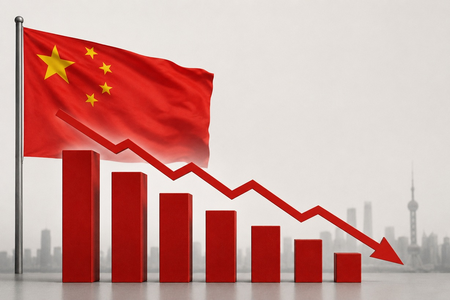
China’s consumer sector is showing renewed signs of weakness, with MSCI China’s consumer goods sub-indices falling about 18 per cent over the past six months and moving close to a decade low.
The sharp decline comes amid mounting concerns over domestic consumption and the uneven performance of the world’s second-largest economy. A report cited by the *Taipei Times* said China’s retail sales growth was just 0.4 per cent in August, underscoring the fragile state of consumer demand.
The weakness was also visible in corporate earnings. During the latest earnings season, consumer durable companies included in the MSCI index fell nearly 50 per cent short of profit expectations, highlighting the growing gap between China’s manufacturing strength and the performance of its domestic consumption sector.
Market analysts have pointed to a growing concentration of investor interest in artificial intelligence and other technology companies. At the same time, the consumption segment has faced broad-based selling, with weak demand becoming a recurring concern during the latest corporate results season.
China has long been regarded as the world’s manufacturing powerhouse, but several parts of its economy are now facing sustained pressure. Key sectors have moved into contraction, while concerns over employment and household spending have added to uncertainty surrounding the country’s growth outlook.
Questions have also emerged over the reliability of China’s official economic data. Government figures have continued to indicate annual growth in the range of 4.5 to 5 per cent, while some independent analysts and institutions have estimated considerably weaker expansion, placing actual growth closer to 2 to 3 per cent.
An analysis published by Kathmandu-based *Hamrakura* argued that economic performance has historically been central to the Chinese Communist Party’s claim to legitimacy. The article said the country’s economic difficulties were becoming increasingly difficult to overlook, particularly as the property sector, which had played a major role in household wealth, has suffered a prolonged downturn.
Weak consumer spending remains another major challenge. Retail sales growth was reported at barely 1 per cent in June 2026, suggesting that households remain cautious about spending and are instead prioritising savings amid broader economic uncertainty.
Rising debt is adding to the pressure, particularly at the local-government level. Elevated borrowing, combined with weakness in the property market and subdued household consumption, has contributed to concerns about the sustainability of China’s current economic model.
The sharp fall in consumer stocks therefore reflects more than a market-sector correction. It points to a broader imbalance in an economy where industrial and technology investment remains important while household demand continues to struggle to regain momentum.
Filed under
About the author
Anupam Pandey
Reporting and storytelling across theBusiness vertical for 4thWall Network.
More from 4thWall
Continue with Business.
Related reporting first, followed by more stories from across the 4thWall Network.

India-New Zealand FTA a Transformative Milestone for Trade Policy: TPCI
30 September 2026

Piyush Goyal Invites US Manufacturers to Explore Investment Opportunities in India
30 September 2026

Sitharaman Urges Qatar Businesses to Explore Trade and Investment Opportunities in India
30 September 2026

Government Notifies CAFE-3 Norms for Automakers, Retains EV Incentives
30 September 2026